Subject
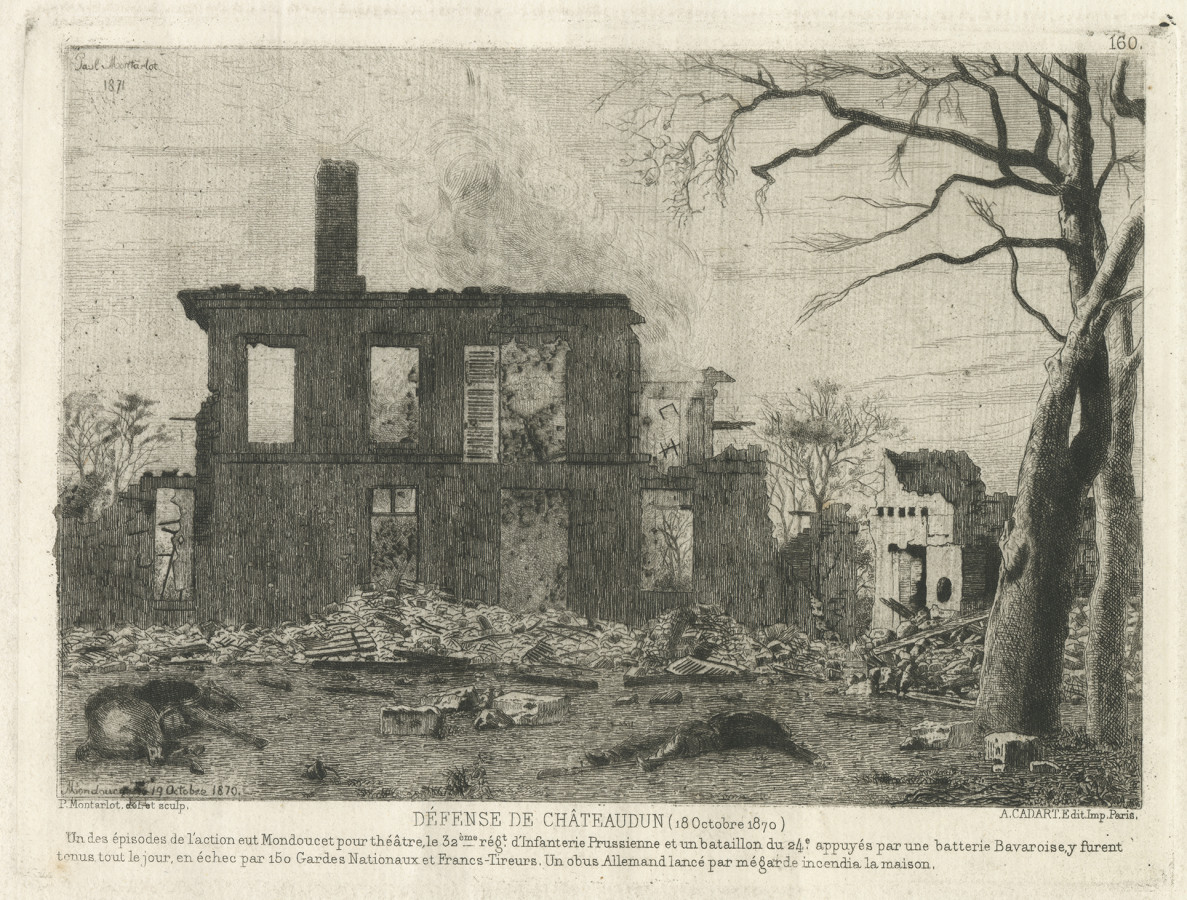
The ruins of the French town of Châteaudun, depicted shortly after its ‘spontaneous’ defence against the Prussian army on 18th October 1870. The defence of the town was conducted by armed civilians (known as franc-tireurs) and members of the Garde mobile, a state paramilitary organisation for able-bodied civilian men not otherwise involved with military service as regulars, veterans or volunteers, created in 1866.
The defence of Châteaudun against overwhelming forces holds a distinctive place in French national mythology, as a instance of heroic popular resistance to foreign invasion. Approximately 1200 barely-trained Gardes and an unknown number of civilians held off the Prussian 22nd Division (a force ten times its size) for twenty four hours of savage house-to-house fighting, much of the combat taking place at night in houses around the town square. In French accounts of the action, the town was burnt by the Prussians as an act of revenge for their humiliation, causing a significant number of civilians to be murdered.
Inscription in the plate: ‘Un des episodes de l’action eut Mondoucet pour theatre, 32eme regiment d’infantrie Prussaine et un batallion du 24th, appuyer par une batterie Bavaroise, y furent tenus tout le jour, en echec par 150 Gardes-Nationales et Franc-Tireurs. Un obus Allemende lance par megarde incenda le maison.’
(One episode of the action took place at Mondoucet. The 32nd Prussian Infantry Regiment and a battalion of the 24th, supported by a Bavarian battery, were held at bay all day by 150 National Guardsmen and Franc-Tireurs. A shell fired by the Germans accidentally set the house on fire.)