- Catalogue number
-
SO 0094
- Artist
-
Jules Jacquemart
- Printer
-
Charles Chardon aîné
- Date
-
1871
- Medium
-
Etching and drypoint
- Dimensions [to plate mark]
-
132 x 184 mm
- Catalogues
-
Gonse, TBI
- State
-
I/I
- Publication
-
L' oeuvre de Jules Jacquemart: Par Louis Gonse, Vol 2, Paris, Gazette des Beaux-arts, 1876.
Subject
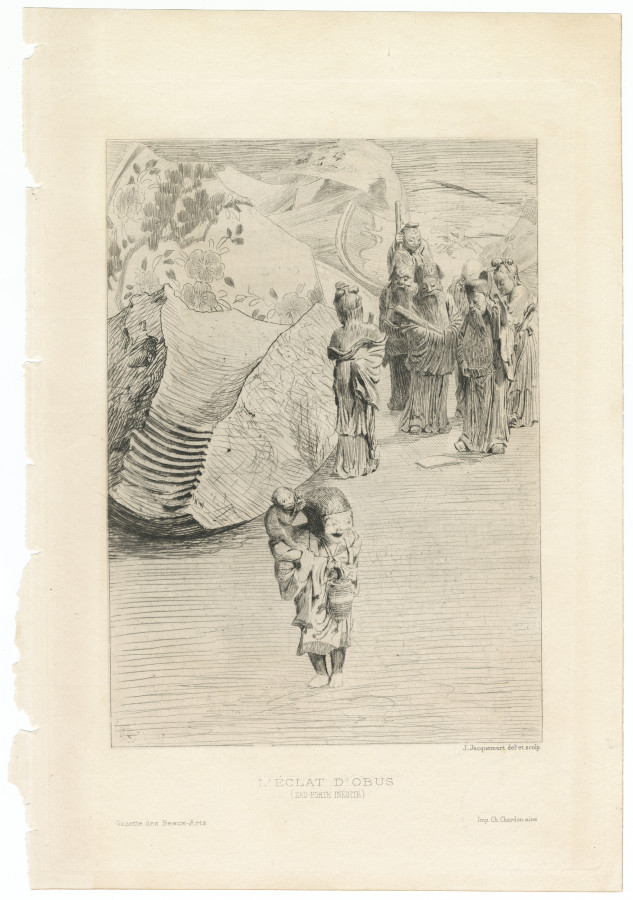
L'eclat d'orbus (The Shell Fragment) depicts a piece of shrapnel - part of the nose of an exploded artillery shell with the threads into which the detonating fuse would have been screwed - together with shards of broken Japanese porcelain and a number of laughing celadon figurines. This paradoxical still-life group dates from the period of the Paris Commune and is a souvenir of the months when Jacquemart was amongst the artists and designers who joined the defence of Paris against the besieging Prussian Army. Jacquement was one of a number of artists who enlisted in the Tirailleurs de la Seine (The Seine Riflemen).
“Pendant le Commune, ma famille sous les obus, là, à cent metre des ramparts, ne voulant pas me laisser, ni partir, et subissant avec moi et nos pauvre collections un bombardment incessant, descendant d'étage en étage a mesure que les murs s'éventraint.”1 (During the Commune, my family was under the shelling, there, a hundred meters from the ramparts, not wanting to leave me, nor to leave, and enduring with me and our poor collections an incessant bombardment, descending from floor to floor as the walls were ripped open.)
The image belongs to a very specific group of works in which progressive French artists recorded their experiences of Paris under siege; contemporary responses included Paul Montarlot's etching Défense de Châteaudun (1871, SO 0063), Théodule Ribot's etching Le village en feu (1870-71), Édouard Manet's lithograph La Barricade (1871), Edgar Degas' painting Femme à la fenêtre (1871-72), James Tissot's painting The execution of Communards by the French government before the fortification in the Bois de Boulogne, 29 May 1871, (1871) and Jean-Louis Meissonier's painting The Ruins of the Tuileries Palace after the Commune of 1871 (1871).
1. Letter from Jules Jacquemart to Hector Giacomelli, July 1874, in Louis Gonse, L' oeuvre de Jules Jacquemart: Par Louis Gonse, Vol 2, Paris, Gazette des Beaux-arts, 1876, p.22.
Printing
Jules Jacquemart's father, Albert Jacquemart, was an important ceramic historian and a member of the editorial board of the Gazette des Beaux-arts. The plate was initially printed in October 1871, as an insert within the first issue of the Gazette des Beaux-arts to be published after the suppression of the Paris Commune. It was subsequently eprinted as Plate 1. in L' oeuvre de Jules Jacquemart: Par Louis Gonse, Vol 2, Paris, Gazette des Beaux-arts, 1876. L' oeuvre de Jules Jacquemart was published in a numbered edition of sixty. Ten examples of the edition included rarer proof etchings avant la lettre, before title and authorship details had been added by the publisher. It appears that the Gazette des Beaux-arts had retained a stock of proofs, lettered impressions and some of Jacquemart's plates, but it may also be correct, as Gonse infers in his text, that proof impressions were acquired from Jacquemart himself.