Subject
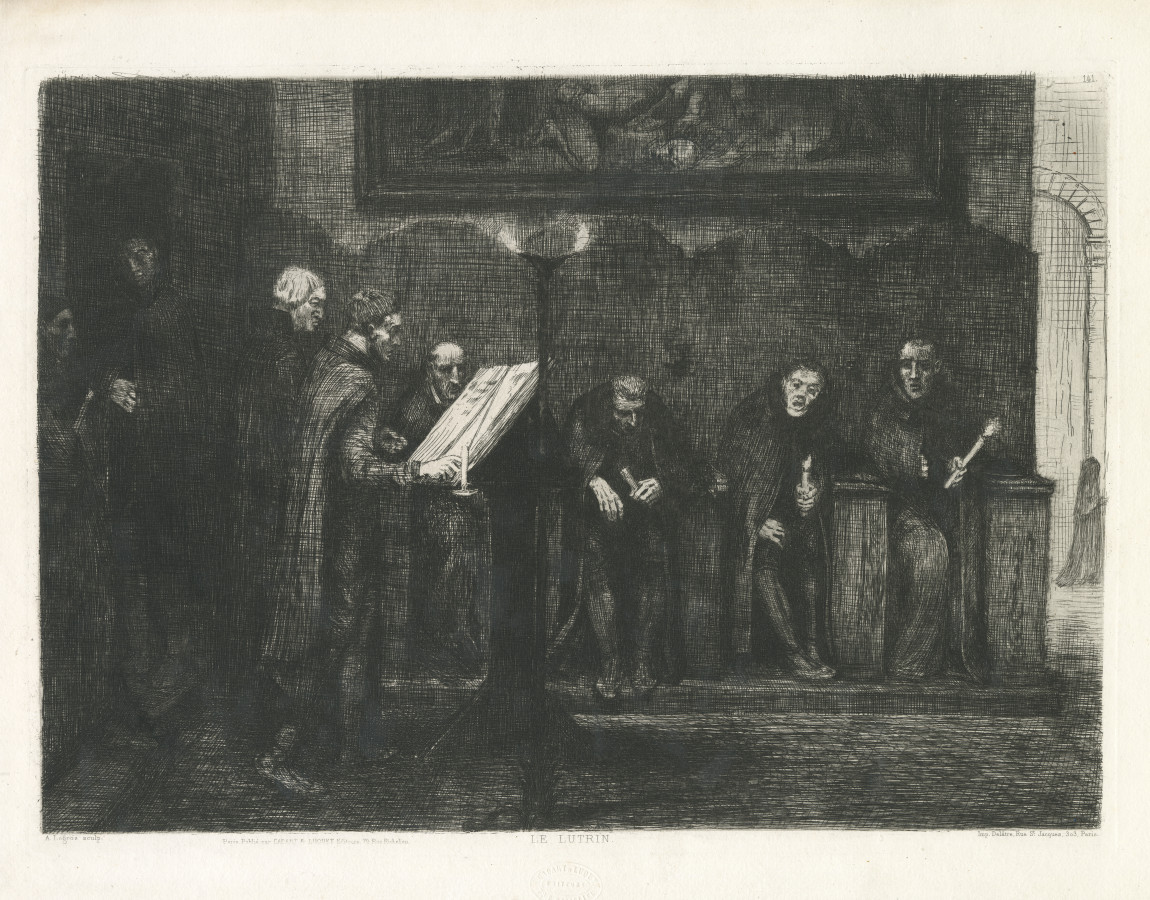
Seated in tall wooden stalls within a church interior, a group of decrepit monks listen to a younger and more vigorous man read from a large book supported on a lectern. The image is characterised by a shallow pictorial space, ‘primitive’ linearity and the near-universal application of dark hatching. Figures may also be seen indistinctly amongst the shadows at the extreme left; a solitary, veiled figure moves beyond the right hand edge. At the top of the plate, the gloomy upper portion of the print reveals a painted scene of execution, the naked male victim still crouched over the block on which the executioner rests his axe, his severed head lying on the ground in front of him.
In his 1877 catalogue raisonné, Paul Poulet-Malassis described the subject:
“Ils sont huit dans le chœur d'une église; les quatre premiers à droite, assis dans des stalles, portent à la main de courts cierges; les autres sont debout; l'un d'eux tourne la page d'un missel posé sur un lutrin qu'éclaire une longue lampe à deux becs.” (There are eight in the choir of a church; the first four on the right, seated in stalls, hold short candles; the others are standing; one of them is turning the page of a missal placed on a lectern lit by a tall double lamp).1
An impression of Chantres Espagnoles was exhibited by Legros at the second Impressionist Exhibition in 1876
Inscriptions beneath the image: ‘A. Legros sculp., Paris, Publié par CADART & LUQUET Editeurs, 79 Rue Richelieu, Le Lutrin, Imp. Delâtre, Rue St. Jacques, 303, Paris.’
Cadart & Luquet blind stamp, bottom centre.
1. Paul Poulet-Malassis and Alphonse Thibaudeau, Catalogue raisonné de l'oeuvre gravé et lithographié de M. Alphonse Legros, Paris, E. Bauer, Libraire-éditeur, 1877