Subject
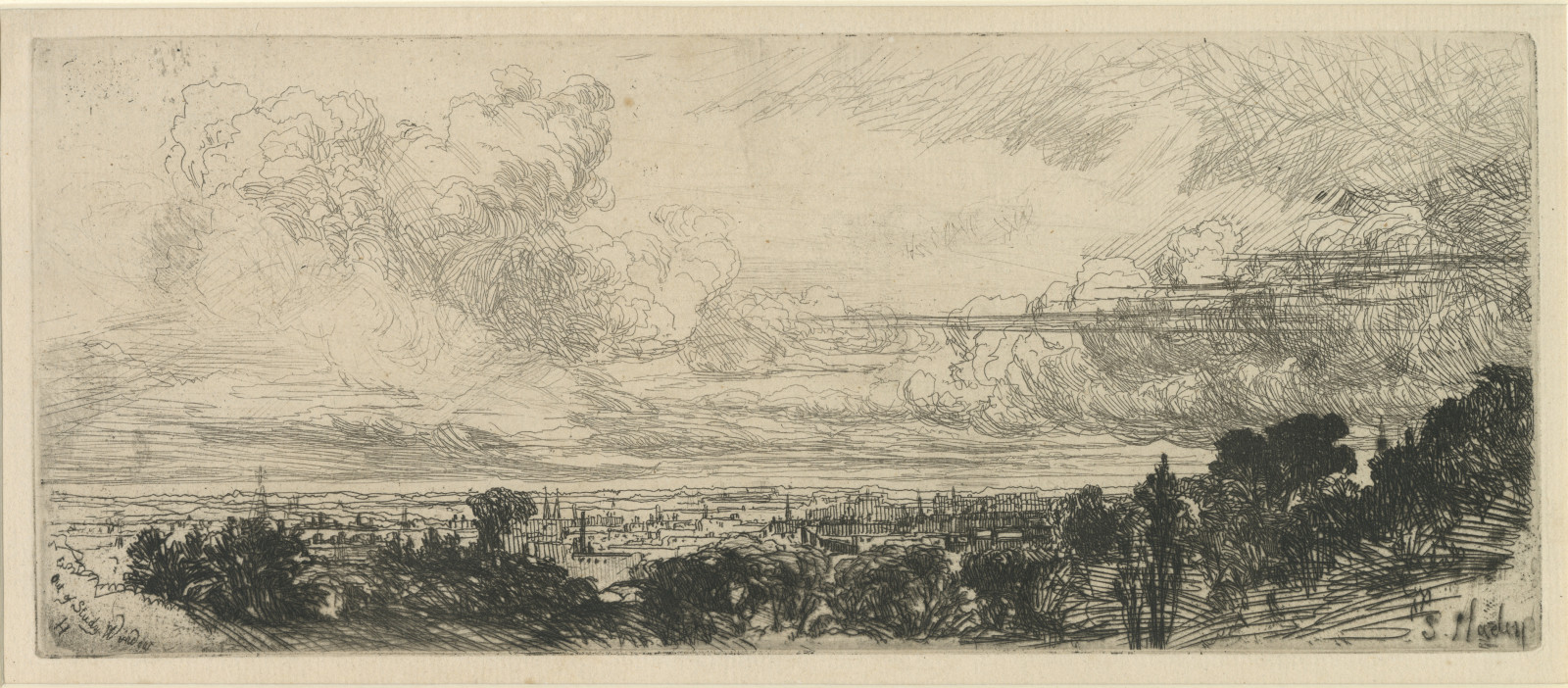
The depicted view is from the rear of Francis Seymour Haden's home at 62 Sloane Street, London, looking west towards what would now be the junction of Exhibition Road and Brompton Road. At the time the plate was etched, the whole area west of Sloan Street was being redeveloped by the Commissioners of the Great Exhibition of 1851. The allotments and market gardens which had characterised the area for several hundred years were being rapidly replaced by the new campus of museums colloquially known as ‘Albertopolis’ together with terraces and squares of substantial Italianate town houses. Amongst these was No.5 Princes Gardens, to which Viscount and Lady Hawarden moved around 1859 and which was the location within which Clementina Hawarden developed her innovative photographic practice. Hawarden's ‘Studies from Life’ were then circulating amongst the network of progressive male artists that included Haden himself, James McNeill Whistler, Édouard Manet and Edgar Degas; her distinctive pictoriality can be identified as a key component of their new Realist aesthetic. However, as a ‘lady amateur’, Hawarden's crucial contribution to new developments in painting was never acknowledged by her male peers and her impact was curtailed by her early death in 1865. Out of the Study Window is amongst the five Haden etchings seen in Hawarden's stereoscopic photograph Isabella Grace Maude and Clementina Maude, 5 Princes Gardens (V&A 457:499-1968).