Subject
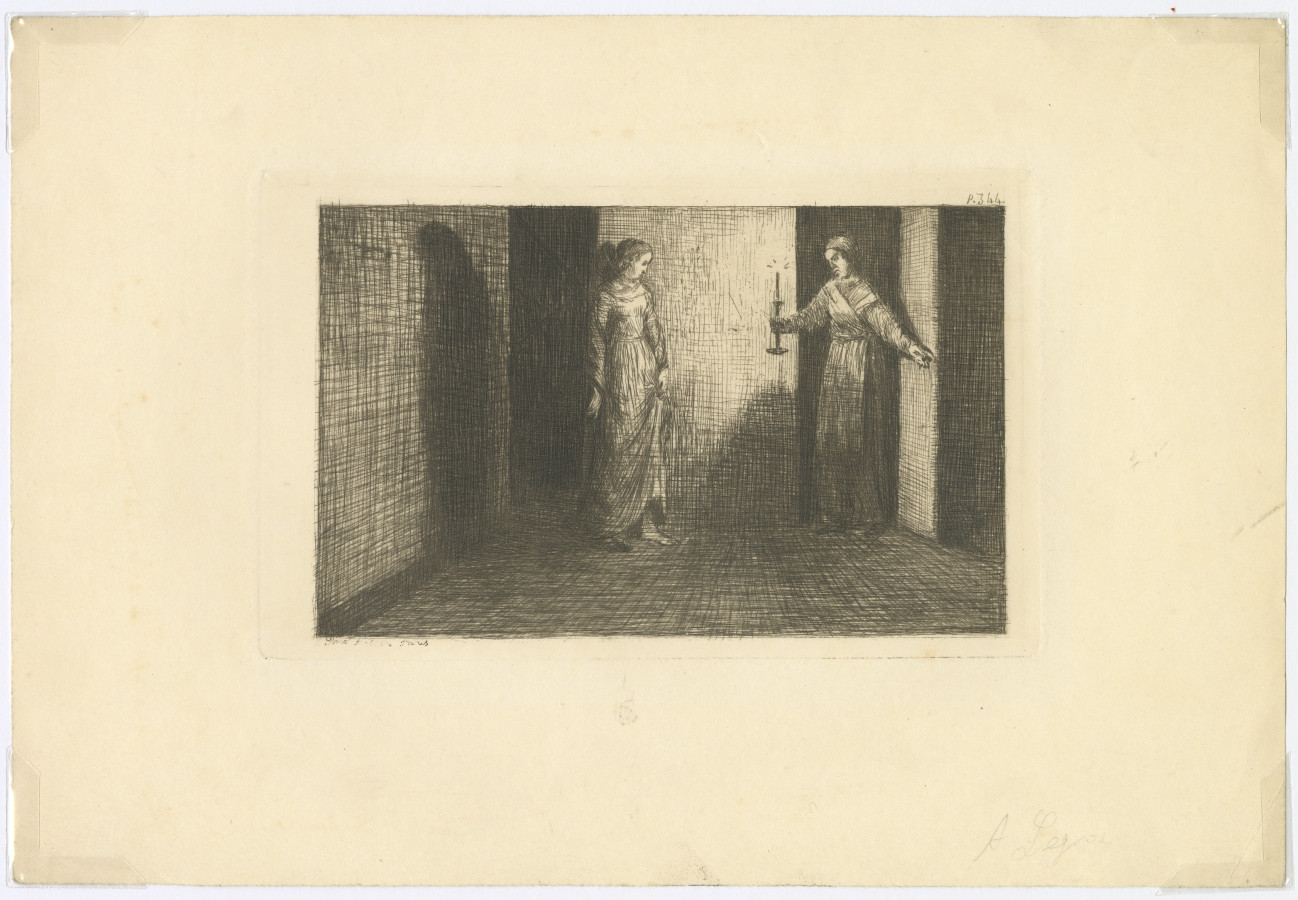
‘Henriette rentrant chez sa mere.’ One of four illustrations provided by Alphonse Legros for an edition of Le malheur d'Henriette Gérard by Louis Edmond Duranty, published in Paris by Poulet-Mallassis et De Broise in 1861 .1 The critic and novelist Duranty was a significant ally of the Realist artists who gathered at the Café Guerbois on the Avenue de Clichy in Paris and who are sometimes known as the ‘Batignolles Group’.
Le malheur d'Henriette Gérard was a Realist novel concerning the sentimental and social destiny of a young seamstress. At the commencement of the story, the teenage heroine falls in love with a penniless medical student called Emile who asks her to marry him. When this relationship is opposed, both by Henriette's family and by Emile's previous lover, she is compelled to marry a wealthy older man called Mathéus. Her motivation is mainly to protect her parents from poverty but she also, secretly, hopes to be able to support Emile. The transactional character of the partnership is symbolised in the novel by the corbeille de mariage or ‘marriage basket’, a traditional, pre-industrial French symbol of fidelity and financial security given by a bridegroom to a bride, then being re-imagined in bourgeois, consumerist terms, as an elaborate cornucopia of luxury textiles, furs, jewellery and art objects presented in a porcelain vase or richly-decorated casket.
Following conversations with her mother in which the corbeille is admired and the purely financial value of the marriage to her family extensively discussed, Henriette comes to understand that her virginity is essentially being sold to Mathéus in exchange for a dowry. She resolves to run away in order to be reunited with Emile but fails to prepare for her departure seriously. On the night of her escape she encounters a powerful rainstorm in the woods surrounding her family home and eventually returns to her mother, cold, wet and feverish. Duranty's description of Henriette's misadventures in the darkness, entangled in the trees of the wood, her clothes soaked through and her shoe lost in the mud, was surely meant to evoke both her turbulent emotional state and to prefigure the real and imagined sexual violence she might soon endure on her wedding night.
Despite the suicide of Emile on the day of her marriage to Mathéus, Henriette eventually triumphs, physically threatening Mathéus with her porcelain corbeille so violently that he subsequently dies of a stroke. Henriette inherits her husband's wealth and confounds her family, thereby fully realising her transition from youthful, sentimental lover to cynical and self-interested adulthood.
This plate illustrates the moment of Henriette's return from the storm and apparent submission to her mother's will. The plate was intended for inclusion between pages 343 and 345 of Chapter XVII, 'L'ODEUR DES FOÏNS MONTE A LA TÈTE' (The Scent of Hay goes to your Head).
1. Paul Emmanuel Auguste Poulet-Malassis (1825 –1878) was a Parisian aesthete and associate of the Realists, a printer and publisher of books with little interest in the realities of the market. In 1868 he was imprisoned and fined (in absentia) for debts accrued partly through his publication of the works of Charles Baudelaire, including Les Fleurs du mal and Le Spleen de Paris. Poulet-Malassis was an avid collector of the etchings of Alphonse Legros and with the art dealer Alphonse Wyatt Thibaudeau he co-authored the Catalogue raisonné de l'oeuvre gravé et lithographié de M. Alphonse Legros, published in 1877. This catalogue remains one of two authoritative historical sources on the etchings of Legros and is acknowledged extensively elsewhere in this work.